REVIEW · BOLZANO
3- Hours Private Tour Bolzano’s Jewish History
Book on Viator →Operated by Italy Destination Services · Bookable on Viator
Walking Bolzano’s Jewish past is sobering.
This private 3-hour route ties together Bolzano’s Jewish history—from medieval trade days to the darkest months of WWII—using real surviving traces and memorials, guided by Claudia. You start in Piazza Walther, then move to the camp-related sites and back through the old center where names are literally set into the cobblestones.
I love how the tour shows you the places tied to suffering and forced labor, not just general context. I especially like the stop at Die Transporte and the rail connection to major camps, and how the walk later points out Stolpesteine brass plates that mark Jewish residents with names and dates.
One possible drawback: this is an emotional, WWII-focused tour. Plan for a serious tone, and wear shoes that handle old-stone streets and outdoor walking, because you’ll be on your feet for much of the 3 hours.
In This Review
- Key highlights you’ll remember
- Piazza Walther meeting point: the route starts with Bolzano’s crossroads
- Bolzano camp wall stop: what forced labour looked like in real life
- Die Transporte rail track: understanding the 13-wagon reality
- City Cemetery and the memorial for 96 deported Jewish residents
- Forced labour memorial by Virgolo Gallery: industry meets cruelty
- Piazza Walther medieval center: trade routes and centuries of Jewish presence
- Stolpesteine in the cobblestones: names, dates, and local victims
- Price and value: what you’re paying for
- Who should book this tour (and who might want a gentler option)
- A note on Claudia’s guidance and a book she shared
- Should you book this Jewish history tour in Bolzano?
- FAQ
- How long is the Bolzano Jewish History private tour?
- Where does the tour start and when?
- Is the tour offered in English?
- Does it include pickup?
- What’s included in the price?
- Do I need tickets or do I pay entry fees at the stops?
- Is there a minimum number of people?
- FAQ
- Can I get a full refund if I cancel?
- What if I cancel within 24 hours of the start time?
- Is the tour private?
- Is the location easy to reach without a car?
- Are most people able to participate?
- Are there group discounts?
- Will I receive a ticket on my phone?
Key highlights you’ll remember
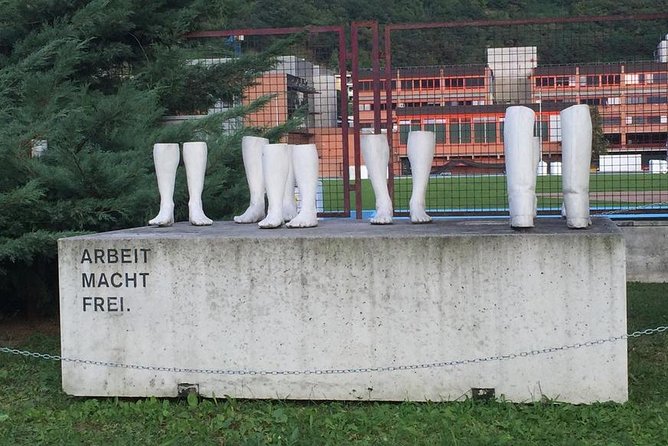
- Concentration Camp remains with forced-labour context tied to the 1944–1945 period
- Die Transporte rail track stop showing prisoner transports to camps across Europe
- Memorials that name victims, including deported Jewish residents from South Tyrol
- Stolpesteine brass plates in the medieval center—personal stories embedded in the ground
- A focused walking route that connects centuries of Jewish presence to WWII events
- Claudia’s storytelling brings timelines into focus and keeps the tour moving clearly
Piazza Walther meeting point: the route starts with Bolzano’s crossroads
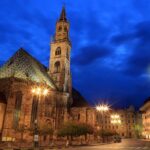
Your tour starts at Piazza Walther (2:00 pm), and the plan is simple: you begin in the medieval heart of Bolzano, then you head out to the camp-related sites, then you return to the old center again. That loop matters. It helps you see how Jewish life in Bolzano wasn’t only a WWII chapter—it stretched back centuries in a trading city on a Transalpine route.
From the beginning, Claudia sets expectations in a way that feels respectful and grounded. The pace is steady, and the guide does a good job making the timeline feel logical instead of scattered.
Practical note: pickup is offered if your hotel is in Bolzano or within 5 km of the city center. Even if you self-transfer, Piazza Walther is easy as a base, with public transport nearby.
You can also read our reviews of more tours and experiences in Bolzano.

Bolzano camp wall stop: what forced labour looked like in real life
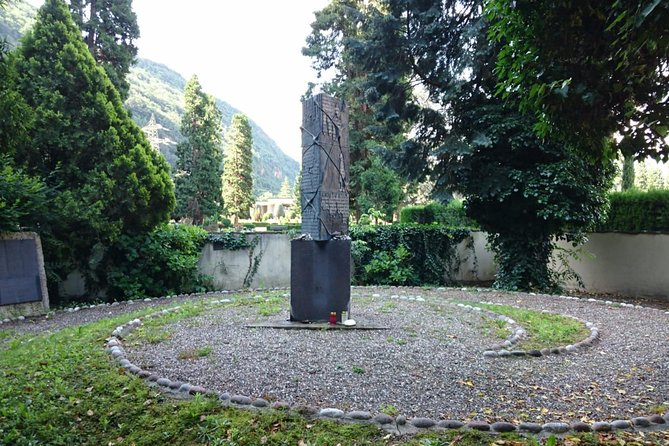
The tour’s first major stop focuses on the site and wall of the Concentration Camp of Bolzano. This wasn’t just a generic prison. It was one of the four concentration camps in Italy, and it’s described as the only one linked to forced-labour camps.
From summer 1944 until April 1945, around 11,000 prisoners—men, women, and children—were kept here. That number isn’t just a statistic. It gives you a scale for what the prisoners faced and why the remnants at this location matter.
You’ll likely notice how the visit is framed: it’s not about dark sightseeing for its own sake. It’s about grounding the story in place. Seeing the physical trace of a camp site makes the later details about transports and memorial names hit harder.
Since admission is free for this stop, you can focus on listening and absorbing instead of budgeting extra fees. Expect it to be quiet and reflective.
Die Transporte rail track: understanding the 13-wagon reality
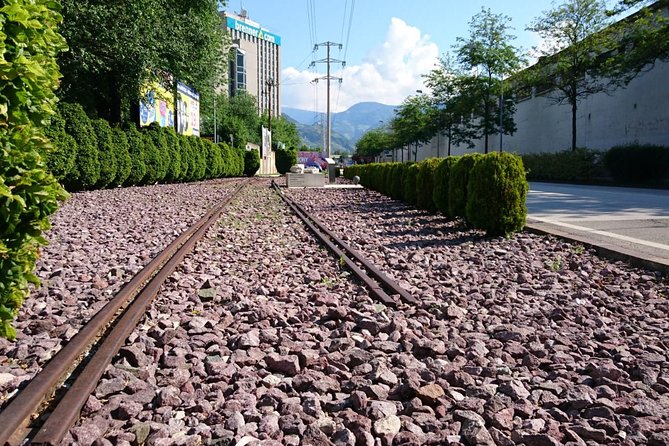
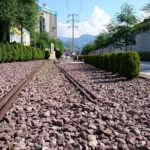
Next comes one of the most pointed stops: the rail track area called Die Transporte. This is where prisoner transports were shipped out. The tour explains that 13 wagons carried prisoners from Bolzano to trans-alpine concentration camps including Dachau, Mauthausen, Flossenbürg, Ravensbrück, and Auschwitz.
Even if you know the basics of Nazi deportations, this stop helps you connect the dots to Bolzano specifically. The guide’s job here is to keep the focus local—Bolzano wasn’t only a place where people were held. It was part of a larger machinery of removal and extermination.
A small practical tip: this part is factual and direct. If you’re the type who likes context first, give Claudia a minute to explain how the logistics worked before you start asking questions in your head. You’ll get a clearer picture.
Again, admission is listed as free for this section, so the cost stays focused on the guide and private transport—more on that value later.
City Cemetery and the memorial for 96 deported Jewish residents
After the rail stop, the tour heads to the City Cemetery, specifically into the Jewish sector. Here, you visit a memorial remembering 96 Jewish South Tyrol residents who were deported by the Nazis and perished in the local camp.
This is where the tour shifts from transport routes back to names and local impact. It’s also where you may feel the difference between understanding history and confronting it. The tragedy isn’t abstract; it’s tied to a specific region and community.
What I like about this stop is that it doesn’t ask you to move on quickly. It gives time for a full mental shift: from Europe-wide camp names you may have heard before, to the faces and families that were from here.
If you’re traveling with someone who tends to struggle with memorial spaces, this can still work. The structure is straightforward, and Claudia’s explanations help people stay connected without feeling lost or overwhelmed.
Forced labour memorial by Virgolo Gallery: industry meets cruelty
The tour’s next stop is a memorial for forced labour, located next to the Virgolo Gallery. Claudia explains that this gallery links to an older industrial role—once important as an arms factory for ball bearings. Camp prisoners were used for labour tied to that production.
That detail is heavy, but it’s also important. It shows how systems of oppression were supported by the everyday economy. Bolzano’s industrial landscape was part of the mechanism that exploited prisoners for work.
This stop adds a layer many WWII tours skip: not just detention and deportation, but the work itself—what was demanded, where it happened, and how buildings and institutions can outlast the violence they served.
You’ll likely walk through an area that feels ordinary, and that’s exactly the point. The tour helps you see how the past can sit quietly under the surface of a working city.



Piazza Walther medieval center: trade routes and centuries of Jewish presence
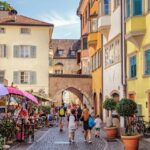
After the camp-related sites, you return to the historic center around Piazza Walther. Here, the tone shifts to longer time spans. Claudia talks about Bolzano’s medieval importance as a privileged trade center on the Transalpine Augsburg–Venice route, and how the Jewish community dates back to the 14th century.
This is one of the tour’s smartest choices. When a tour starts and ends only with WWII, you lose the full human arc. By showing Jewish life stretching back centuries, you understand why the WWII persecution wasn’t the start of the story—it was a brutal rupture.
If you only do one WWII experience in the area, you can still appreciate this, because it gives you context that most memorial visits don’t provide.
Stolpesteine in the cobblestones: names, dates, and local victims
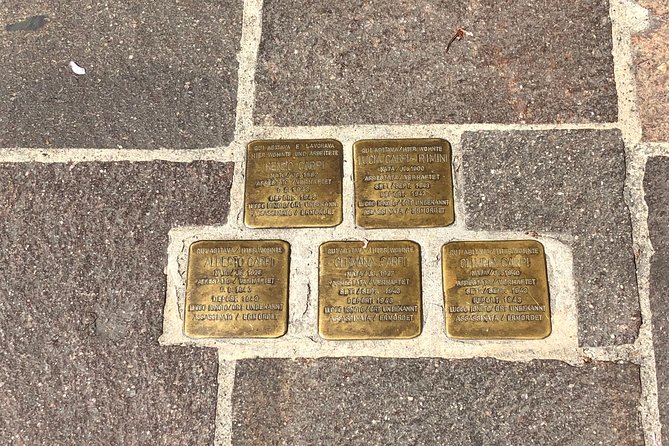
One of the walk’s best moments is spotting Stolpesteine—brass plates set into cobblestones. Each one is inscribed with the name and life dates of Jewish residents in Bolzano who were victims of Nazi persecution.
You’ll likely slow down as you pass them. That’s normal. These plates work like tiny reminders that the people were real, specific, and part of daily streets—not only victims in books.
For me, this is where the tour becomes personal without becoming sentimental. You’re not just told that lives were taken. You’re shown how the city remembers in small, exact markers.
The tour finishes in front of Café Mozart, which is a nice practical way to end. You can sit, regroup, and decide if you want to talk more—or just take a breath.
Price and value: what you’re paying for
At $250.78 per person for a private 3-hour experience, this isn’t a bargain-basement option. But it also isn’t trying to be. You’re paying for three things that matter:
- A professional guide who can connect locations to timelines clearly (and keep the tone respectful).
- Private vehicle transport between the different sites, so you’re not stitching together buses while carrying the emotional weight of the route.
- Your own group only, with the option of pickup if you’re within 5 km of the center.
Admission fees for the key stops are listed as free, and the tour includes taxes and handling. So your main extra costs are simply food and drinks, since those aren’t included.
If you can split the cost among your group, a private format tends to feel more efficient. Even for couples, it can be worth it when you want a focused conversation rather than a crowded group shuffle.
Who should book this tour (and who might want a gentler option)
This tour fits best if you want a structured, place-based account of Bolzano’s Jewish past—especially the WWII deportation and forced-labour story—with the guide connecting it to earlier Jewish presence.
It’s also ideal if you like tours where the guide points out exact details as you walk, like the Stolpesteine placements.
It may feel too intense if you’re looking for light sightseeing, or if memorial-heavy tours tend to drain you quickly. In that case, you might prefer a shorter or more general historic walking tour first, then add something focused later when you’re ready.
A note on Claudia’s guidance and a book she shared
The most consistent theme from the experience is how well Claudia explains the locations and keeps context clear. People specifically praised how she describes Jewish impact across centuries and how she brought the WWII sites to life with explanations that make the facts easier to hold.
After the tour, Claudia shared a reading recommendation: Nazi on the Run by Gerald Steinacher, available on Kindle. If you want to keep the thread going after you leave Bolzano, that’s a helpful next step.
Should you book this Jewish history tour in Bolzano?
Yes, if you want a focused private walk that ties Bolzano’s Jewish story to real camp-related sites and local memorials—and then brings you back to the medieval center where you can see the longer arc of the community. The route is efficient, the sites are specific, and Claudia’s explanations clearly help you connect the dots instead of just visiting places.
Skip it if you’re not ready for WWII persecution and forced-labour themes, or if you’d rather start with a lighter introduction to Bolzano’s old town. This is a meaningful, serious tour. When you choose it, choose it with that in mind.
FAQ
How long is the Bolzano Jewish History private tour?
It’s about 3 hours.
Where does the tour start and when?
It starts at Piazza Walther in Bolzano, at 2:00 pm. It ends back at the meeting point.
Is the tour offered in English?
Yes, English is listed as an offered language.
Does it include pickup?
Pickup is offered if your hotel is in Bolzano or within 5 km of the city center. Note that hotel pickup and drop-off are listed as not included, so it’s worth confirming what’s available for your exact accommodation.
What’s included in the price?
You get a professional guide, transport by private vehicle, and all taxes, fees, and handling charges. Food and drinks are not included.
Do I need tickets or do I pay entry fees at the stops?
Admission is listed as free for the stops.
Is there a minimum number of people?
Yes, there’s a minimum of 2 people per booking.
FAQ
Can I get a full refund if I cancel?
Yes. Free cancellation is available if you cancel up to 24 hours before the experience’s start time.
What if I cancel within 24 hours of the start time?
If you cancel less than 24 hours before the start time, the amount paid won’t be refunded.
Is the tour private?
Yes. It’s private, meaning only your group participates.
Is the location easy to reach without a car?
The start point is near public transportation.
Are most people able to participate?
The tour notes that most travelers can participate.
Are there group discounts?
Yes, group discounts are listed.
Will I receive a ticket on my phone?
Yes, you’ll get a mobile ticket.