REVIEW · VERONA
Dante in Verona: From Inferno to Paradise
Book on Viator →Operated by Slow Travel Italia · Bookable on Viator
Dante turns Verona into a walking poem. This 1 hour 30 minute stroll connects the city’s corners to the life of Dante Alighieri and the mood shift from Inferno to Paradise. I love that the guide makes literature feel grounded in real streets and real buildings, and I love that you get both famous landmarks and calmer backstreets in one smooth loop.
One thing to consider is the pace: it’s a set walking route with short stops, so if you want long, slow museum-style hangs, this won’t feel like that. Comfort in warm weather matters too, since Verona can get hot.
In This Review
- Key highlights you’ll actually feel
- A Dante walk that goes from Inferno hints to Paradise calm
- Who this tour suits best (and who might want something else)
- Where the tour starts and ends (so you don’t waste time)
- The Alighieri chapel church: Dante’s world gets a real address
- A tower clock with a past: protection, rivals, and power
- Piazza dei Signori: Dante’s statue and the Inferno-linked vibe
- Via Sottoriva: one of Verona’s oldest streets, with views out to Torricelle
- Arche Scaligere: Gothic tombs and Cangrande I’s connection to Dante
- Cattedrale di Santa Maria Matricolare: the Paradise stop in Romanesque calm
- The guides: where the story really lives
- Price and value: what you’re paying for
- What to expect from the pacing and route
- Tips so you get more out of the 90 minutes
- Should you book Dante in Verona: From Inferno to Paradise?
- FAQ
- How long is the Dante in Verona tour?
- What does it cost?
- Is the tour offered in English?
- Is the ticket mobile?
- Where do I meet and where does it end?
- How big is the group?
- Do I need to pay admission at the stops?
- Can I join if I’m not a Dante expert?
- Is service animals allowed?
- What is the cancellation window?
Key highlights you’ll actually feel
- A Dante-themed route that moves from darker symbolism toward a calmer church stop
- Cangrande I connection at the Arche Scaligere and why Dante cared about power
- Off-the-beaten-track church time at the Cattedrale di Santa Maria Matricolare
- Small group size (max 15) for questions and a more conversational flow
- English mobile ticket for an easy start (no paper hunt)
A Dante walk that goes from Inferno hints to Paradise calm

This tour is built around a simple idea: you don’t just learn about Dante Alighieri, you see how Verona shaped the man behind the Divine Comedy. You’ll move seat-by-seat in your imagination, starting with places tied to his world and ending in a quieter, more inward-feeling church.
What makes it work is the balance. You get enough context to follow the story even if you’re not reciting Dante in the original Italian. And you still get the satisfying details that make the stops feel specific, not generic. By the end, Verona doesn’t just look like Verona. It starts to read like a poem.
You can also read our reviews of more tours and experiences in Verona.

Who this tour suits best (and who might want something else)
You’ll likely enjoy this if you:
- like literary travel, where stories connect to real places
- want a guided framework for Dante’s life without needing a full lecture
- appreciate short walking tours that still feel meaningful
It may not be the best fit if you’re after heavy museum time, because most stops are brief. This is more like walking and listening than standing in galleries and taking your time for an hour per room.
Also, it helps to be comfortable walking a town route for about 90 minutes. Most people can join, and service animals are allowed, but it’s still a real walk through the city.
Where the tour starts and ends (so you don’t waste time)
The tour begins at Stradone S. Fermo, 3, 37121 Verona VR, Italy. It ends at the Cattedrale di Santa Maria Matricolare, Piazza Vescovado, 37121 Verona VR, Italy.
Why that matters: you’re not retracing every step back to the start. It’s easier to pair this with other Verona plans afterward, especially if you’re headed toward the cathedral area.
If you’re using transit, the tour is near public transportation, so you should be able to reach the start without turning your trip into a parking-lot mission.
The Alighieri chapel church: Dante’s world gets a real address
The first major stop focuses on a church Dante used to frequent when it was built. Today it contains a chapel made by his family, the Alighieri.
This is the kind of stop that changes your mental picture. Instead of thinking of Dante as only a writer in Florence-from-a-distance, you start seeing him as someone tied to family, neighborhoods, and local identity. A chapel dedicated to the family name is a powerful anchor: it gives Dante a physical presence in Verona.
Possible drawback: because this is a story-driven stop, you’ll want to listen closely during the explanation rather than just treating it as a quick photo stop.
A tower clock with a past: protection, rivals, and power
Next you’ll see a structure that looks like a tower clock now, but originally functioned as a defensive tower for a noble family, built to protect them from rival families.
This matters because it connects medieval Verona’s social system to what you read in the Divine Comedy. Dante wasn’t writing in a vacuum. When politics is personal and rivals are real threats, you get sharper edges in the literature—more urgency, more judgment, more social detail.
Even if you don’t know Verona’s factions yet, the guide’s job here is to give you that baseline. You’ll start to notice the city as a map of relationships, not just a set of pretty buildings.


Piazza dei Signori: Dante’s statue and the Inferno-linked vibe
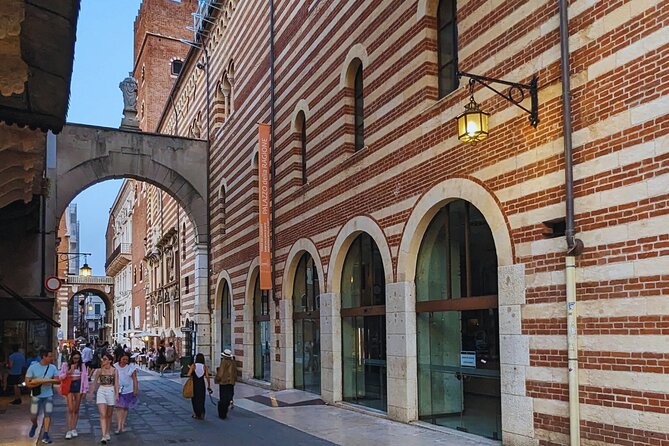
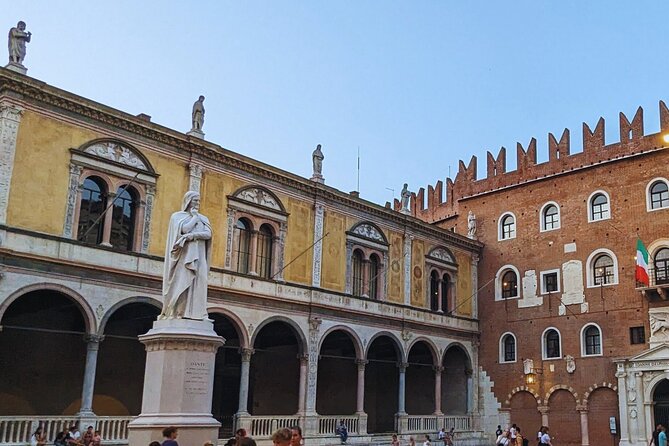
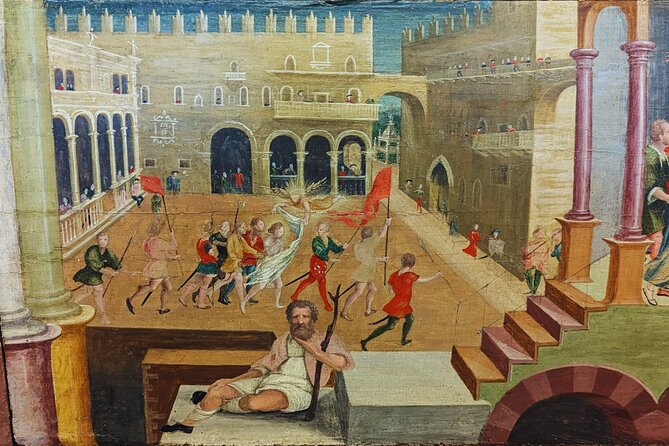
Then comes Piazza dei Signori, Verona’s ancient square where the tour discusses Dante’s life, including his statue.
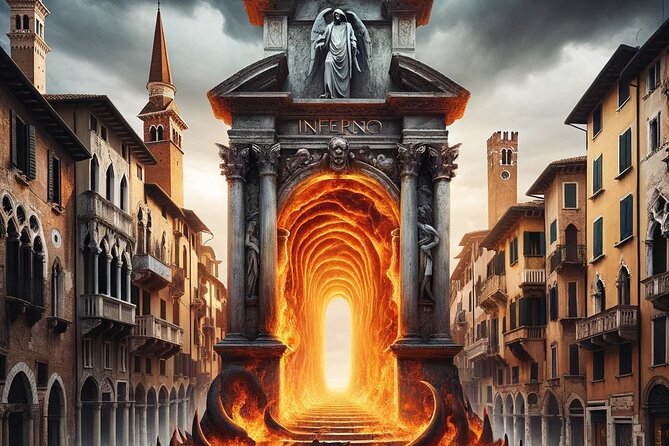
This stop is also about symbolism. The square contains cultural points connected to Inferno themes, and the guide explains why these kinds of spaces mattered to Dante’s time—both culturally and politically. You’ll get a sense of how the public stage shaped private writing.
Practical tip: this is a great place to pause your phone and just take in the square. Even a brief moment of stillness helps Dante’s references click.
Via Sottoriva: one of Verona’s oldest streets, with views out to Torricelle

After the big square energy, you shift to Via Sottoriva, described as one of Verona’s oldest and best-preserved streets, with views toward the hills of Torricelle.
This is a palate cleanser in a smart way. Instead of another monument, you get a walking street where the city feels human-scale. It’s also a good spot for photos, since the street’s preserved look and the sightlines toward the hills give you variety without needing a long detour.
If you’re traveling in warmer months, you’ll probably appreciate the rhythm here—less “stand still and listen,” more “walk and absorb.”
Arche Scaligere: Gothic tombs and Cangrande I’s connection to Dante
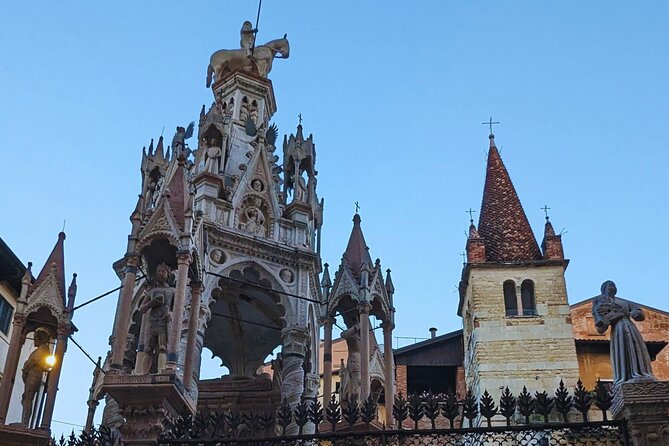
The tour heads to the Arche Scaligere, elaborate Gothic tombs, including the resting place of Cangrande I della Scala.
Here’s where the literary link gets satisfying. The tour explains that Dante admired Cangrande, and that admiration shows up through references in the Divine Comedy. In other words, you’re not just looking at impressive funerary architecture. You’re seeing how political figures made their way into literature.
This stop helps you understand something useful: Dante’s work often sits at the intersection of ideas and real people. Court alliances, reputations, patronage—those things show up in the text, even when they’re not obvious at first reading.
If you’re a Dante fan, this is one of the stops that makes the whole tour feel worth it. If you’re new to Dante, it still works because the story gives you a clear “why should I care” moment.
Cattedrale di Santa Maria Matricolare: the Paradise stop in Romanesque calm
Finally, you end at the Duomo di Verona – Cattedrale di Santa Maria Matricolare, described as a Romanesque church in a more off-the-beaten-track setting, where the tour frames the atmosphere as peace like Paradise.
This ending is intentional. You start with structures tied to noble conflict and Dante’s Verona world, and you finish in a calmer religious space that changes the tone of the walk. It’s a neat emotional arc, and it makes the whole theme feel more than a gimmick.
As a traveler, I like endings like this because they give your brain somewhere to land. You’re not forced to keep chasing sights right up to the finish line.
The guides: where the story really lives
This tour’s success depends on narration, and the reviews line up on one thing: the guides know how to weave Dante’s life into what you’re seeing in front of you.
Names you’ll hear from past participants include Leonardo, Giovanni, and Leo. Different people, same strength: they keep the pace lively and the explanations clear enough that even if you don’t come in as a Dante scholar, you still feel caught up.
One practical note from the experience feedback: guides take care of people during hot days. If you’re booking in summer, don’t ignore basics like water and shade breaks, even on a “just 90 minutes” tour.
Price and value: what you’re paying for
The price is $42.05 per person for about 1 hour 30 minutes. That sounds simple, but the value depends on what’s included—and here, it’s fairly strong.
You’re paying for:
- an English-speaking guide who turns places into story
- a route with multiple major stops linked to Dante
- a small group cap of 15, which usually keeps questions and attention realistic
- a mobile ticket, which makes your entry smoother
Also, each stop listed is marked as free admission, including Piazza dei Signori, Via Sottoriva, the Arche Scaligere segment, and the cathedral stop.
So the cost isn’t inflated by museum fees. You’re mostly buying the walking narrative and city orientation. If that’s the kind of travel you like, this price makes sense.
One more timing thought: the experience is often booked about 10 days in advance on average. If you’re traveling in peak season, I’d plan ahead instead of assuming you can wing it.
What to expect from the pacing and route
You should expect a series of short stops rather than a slow, wandering stroll. Some stops are around 10 minutes, others closer to 15, so the rhythm is: listen, look, move.
That’s not a bad thing. In fact, it’s a smart match for Dante. A single long pause at one monument can make the story feel fragmented. Short segments keep the theme moving: Dante’s Verona in steps, moving from street to square to tombs to church.
Tips so you get more out of the 90 minutes
Here’s how to make the most of it without overthinking:
- Wear comfortable shoes. This is a walking tour through old streets.
- If you come with zero Dante knowledge, that’s fine—just keep listening for names, places, and the main links to the Divine Comedy theme.
- Bring water in warm months. Even a short tour can feel longer when the sun is strong.
- Use your phone for the mobile ticket, but don’t bury your guide in the screen. The best parts are the connections between what you see and what you’re hearing.
- Arrive a few minutes early so you can settle before the first story beat.
Should you book Dante in Verona: From Inferno to Paradise?
I think you should book this if you want a guided way to “read” Verona through Dante’s lens. It’s a good match for first-time visitors who want more meaning than a photo walk, and it’s a solid hit for Dante fans who want the city to speak back.
I’d skip it (or choose a different style of tour) if you prefer long stays in each location, or if you dislike structured walking routes. The tour is short, tight, and story-led—so your best experience comes when you’re ready to listen as you walk.
Overall, at $42.05 with a small group cap and multiple free-admission stops, you’re buying a lot of interpretation for your time. If you enjoy that kind of travel, this is an easy yes.
FAQ
How long is the Dante in Verona tour?
It’s approximately 1 hour 30 minutes.
What does it cost?
The price is $42.05 per person.
Is the tour offered in English?
Yes, it’s offered in English.
Is the ticket mobile?
Yes, the tour uses a mobile ticket.
Where do I meet and where does it end?
You start at Stradone S. Fermo, 3, 37121 Verona VR, Italy and end at Cattedrale di Santa Maria Matricolare, Piazza Vescovado, 37121 Verona VR, Italy.
How big is the group?
The maximum group size is 15 travelers.
Do I need to pay admission at the stops?
The stops listed are marked as admission ticket free.
Can I join if I’m not a Dante expert?
Most travelers can participate, and the experience is designed to help you connect Dante’s life and themes to places in Verona.
Is service animals allowed?
Yes, service animals are allowed.
What is the cancellation window?
Free cancellation is available up to 24 hours in advance of the experience start time for a full refund.