REVIEW · VERONA
Verona: City Highlights Private Tour
Book on Viator →Operated by Citywalkers · Bookable on Viator
Verona clicks faster with a private guide. This 2.5-hour walking tour lines up Verona’s big landmarks—from the Roman Arena to Juliet’s house—then lets you adjust what you linger on.
I like that the guide ties each stop to what you can actually see. You’ll get real meaning behind places like Piazza delle Erbe and the Arche Scaligere, and the stops that are marked free on the plan keep the experience feeling like good value.
One watch-out: this is a walking highlights route, and lunch isn’t included, so it helps to plan something simple afterward.
In This Review
- Key things that make this tour work
- A 2.5-hour private loop from Piazza Bra to Juliet
- Entering the Roman Arena from Piazza Bra
- Scaliger power: castle, Ponte Scaligero, and the Gavi arch story
- Piazza delle Erbe: the Roman forum that never quit
- Arche Scaligere: Gothic tombs and the meaning of della Scala
- Piazza dei Signori: Verona’s living room and Dante’s statue
- Casa di Giulietta: the 12th-century house behind the legend
- When a private guide actually adds value
- How to get the most from the route (without turning it into stress)
- Who should book this tour, and who might pass
- Should you book the Verona City Highlights Private Tour?
- FAQ
- How long is the Verona City Highlights Private Tour?
- What’s the group size limit?
- Where does the tour start and end?
- What language is the tour offered in?
- Is lunch included?
- Are there entrance fees for the stops?
Key things that make this tour work
- Private, up to 2 people: you’re not herded with strangers, and the guide can match your pace.
- Arena + Scaliger sites in one loop: Roman spectacle and medieval power, close together.
- Free stops built into the route: Piazza delle Erbe, Arche Scaligere, Piazza dei Signori, and Casa di Giulietta are listed as free.
- White marble arch with a twist: the Arch of the Gavia story includes dismantling and reassembly in 1932.
- Juliet area at the finish: you end near Juliet’s Balcony so you don’t have to backtrack.
A 2.5-hour private loop from Piazza Bra to Juliet
This tour is designed like a tight walk across central Verona. You start at Piazza Bra, the big square dominated by the Roman Arena, then you work your way through medieval defenses, civic squares, and finally end near Casa di Giulietta on Via Cappello.
Because it’s private and sized for up to two people, it’s ideal if you want to ask questions without shouting over a crowd. It also tends to suit first-timers, since you get a clean overview before you strike out on your own later.
It’s offered in English, and you get a mobile ticket. Also, service animals are allowed, and the tour says most travelers can participate—so if you’re comfortable walking for a couple hours, you’re likely fine.
You can also read our reviews of more tours and experiences in Verona.


Entering the Roman Arena from Piazza Bra
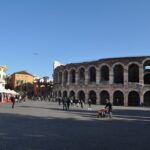
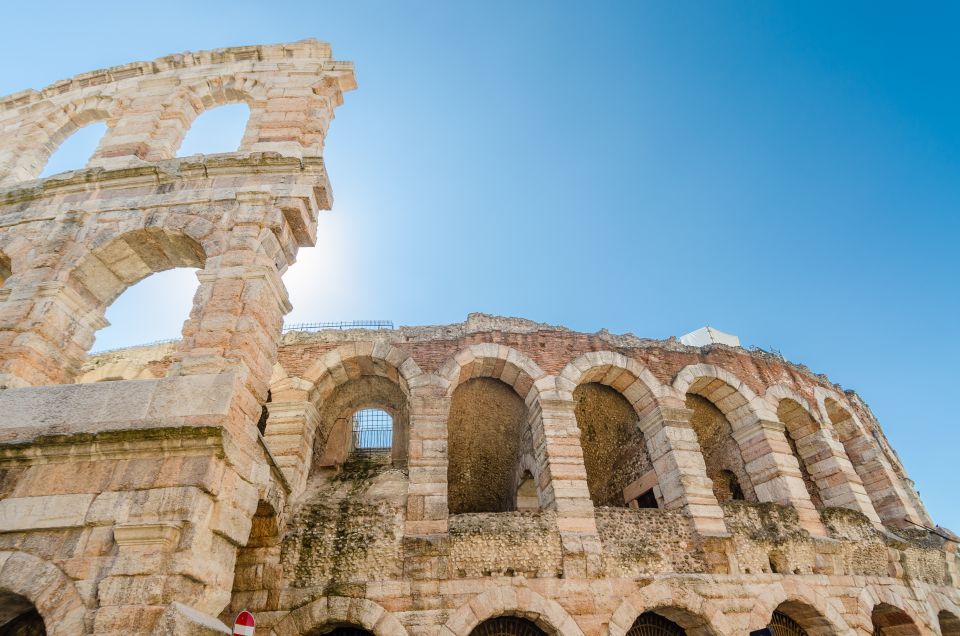
The Arena is the kind of sight that changes your sense of scale fast. From Piazza Bra, it’s hard not to notice the dimensions: about 140 meters long and 110 meters wide. This is the world-famous Roman amphitheater built in the 1st century AD, and it’s known for its great acoustics.
Even if you don’t go deep into technical details, the guide’s framing helps. The Arena wasn’t just for shows—it still supports music and entertainment today, and the seating capacity is listed at 30,000 people. That’s the key idea: this place wasn’t a one-time Roman project; it became part of how Verona’s culture performs.
Practical tip: wear shoes with decent grip. Piazza Bra and the surrounding streets are classic old-city surfaces—fine for a stroll, but not ideal for flip-flops after a long day of walking.
Scaliger power: castle, Ponte Scaligero, and the Gavi arch story
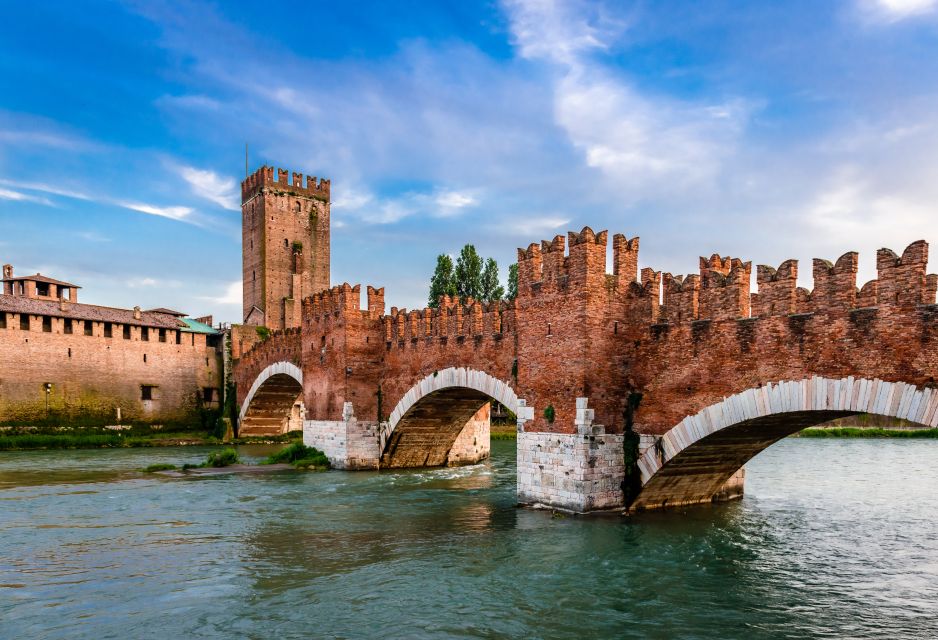
After the Roman centerpiece, the tour shifts to the medieval muscle that made Verona hard to ignore. The “famous castle” here is tied to the Scaliger dynasty, described as the most important military construction of their rule. You’ll also hear how Verona’s defenses connected across the Adige River.
That connection is Ponte Scaligero, the fortified bridge. The details are unusually specific: when completed in 1356, it had the largest supporting arch span in the world. That kind of fact makes the bridge feel less like a background photo and more like a serious engineering statement.
Then comes a curveball that I really like for storytelling value. The tour points out the Arch of the Gavia, built in white veronese marble and dedicated to the Gavia family in the 1st century. Here’s the twist: it used to stand in the middle of Corso Castelvecchio, linking Verona with Rome, but the French dismantled it because it hindered traffic. The pieces were dumped under the arches of the Arena, and the arch was reassembled piece by piece in 1932.
That arc—from Roman route marker, to dismantled obstacle, to reassembled monument—gives you a clearer picture of how cities reuse space and meaning over time. Verona isn’t frozen in one era. It layers them.
Piazza delle Erbe: the Roman forum that never quit
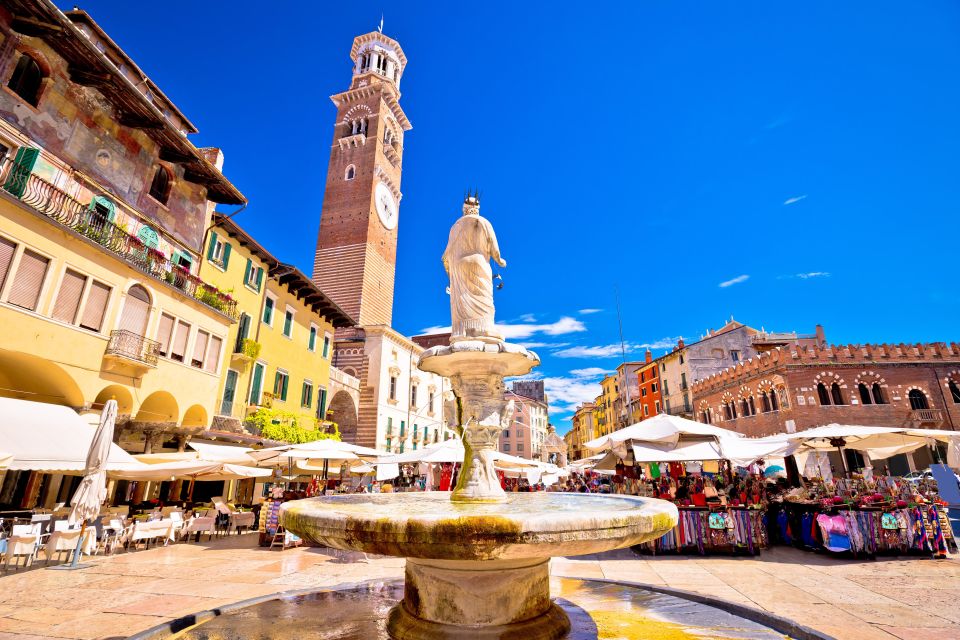
Piazza delle Erbe is where Verona’s civic life shows up in plain sight. The plan calls out that the Forum, the center of Roman city life, once stood here. And the vibe matches: it’s still a meeting place and a market square, with administration functions tied to the space.
Look at the center monuments. The fountain is especially memorable: it was built using a Roman statue during Scaliger rule, and it became known as Madonna Verona. That connection—Roman pieces repurposed into medieval symbolism—is exactly the sort of thing a guide can point out in the moment, not just in a book later.
You’ll also see:
- Gardello Tower (14th century) across the square
- Baroque Palazzo Maffei on the square
- The courtyard of Palazzo del Comune, which leads onward toward Lamberti Tower for panoramic views
Even if you don’t climb Lamberti Tower during the tour, you’ll get the direction and context so your later visit feels easier.
The stop is listed as about 10 minutes and marked admission ticket free, which matters because it keeps you from feeling like you’re stuck in lines or paying for every corner of the city.
Arche Scaligere: Gothic tombs and the meaning of della Scala
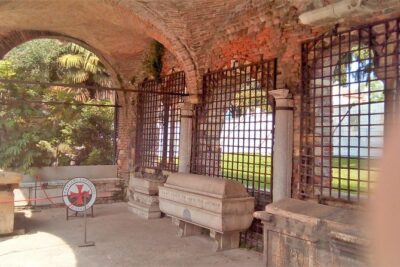
Next is Arche Scaligere, the funerary tombs of the Scaliger family who ruled in the 13th and 14th centuries. These are described as outstanding Gothic monuments, and they’re set inside an enclosure of wrought iron grilles with a stair motif.
That stair motif isn’t decorative trivia. It ties to the family name. The tour notes that della Scala is connected to the idea of stairs in Italian, which helps you connect language to architecture.
This stop is also listed as about 10 minutes and admission ticket free. For value, that’s a win. For emotion, it’s a different kind of moment than the piazzas: the architecture pushes you to slow down and look carefully, since the details are the point.


Piazza dei Signori: Verona’s living room and Dante’s statue
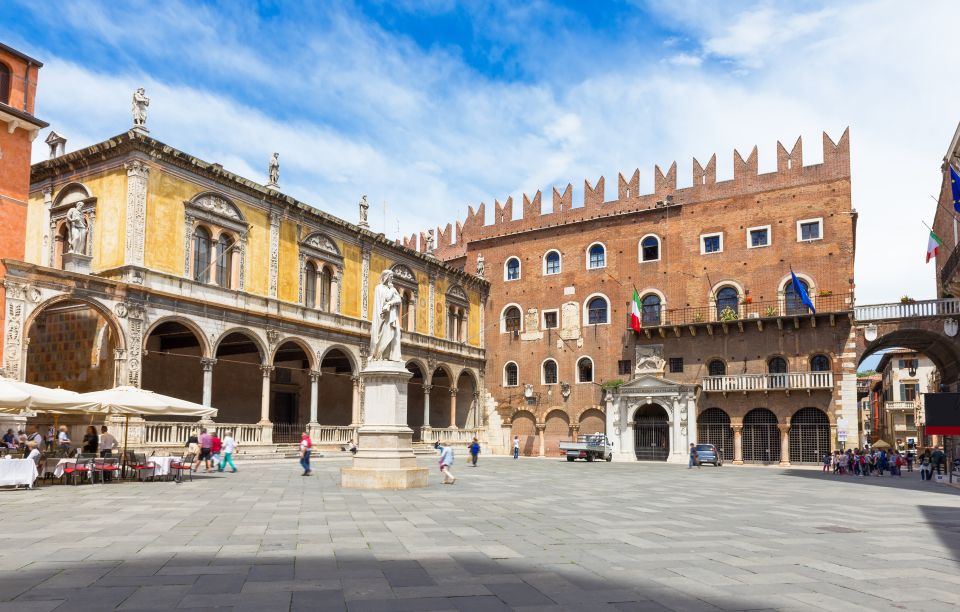
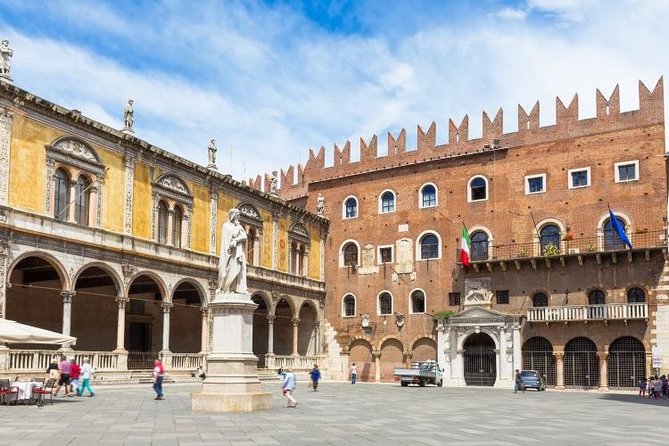
If Piazza delle Erbe is about markets and administration, Piazza dei Signori is Verona’s polished public stage. It’s often described as the city’s refined living room, and it’s also called Piazza Dante because of the statue of Dante Alighieri in the center.
Around the square, you’ll find major Renaissance buildings forming the edges of the “room,” including:
- Palazzo della Ragione
- Palazzo del Capitano
- Palazzo del Governo
- Loggia del Consiglio
- Domus Nova
The tour notes that these buildings still play roles in political and administrative functions during the day. It also mentions that the square is a gathering spot for university students, which helps explain why it doesn’t feel like a museum courtyard. It feels like a place where people actually live their days.
This is another stop marked 10 minutes and admission ticket free. It’s a smart use of time: you get big-city architecture and social context without turning your tour into an endurance test.
Casa di Giulietta: the 12th-century house behind the legend
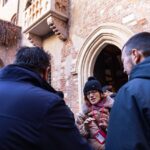
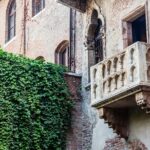
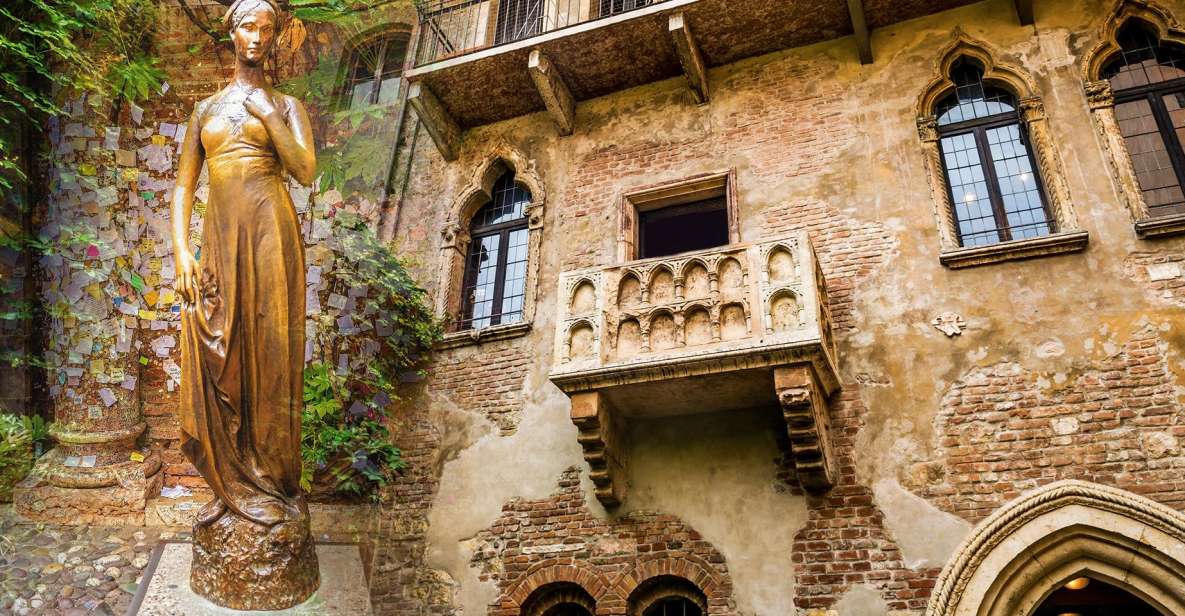
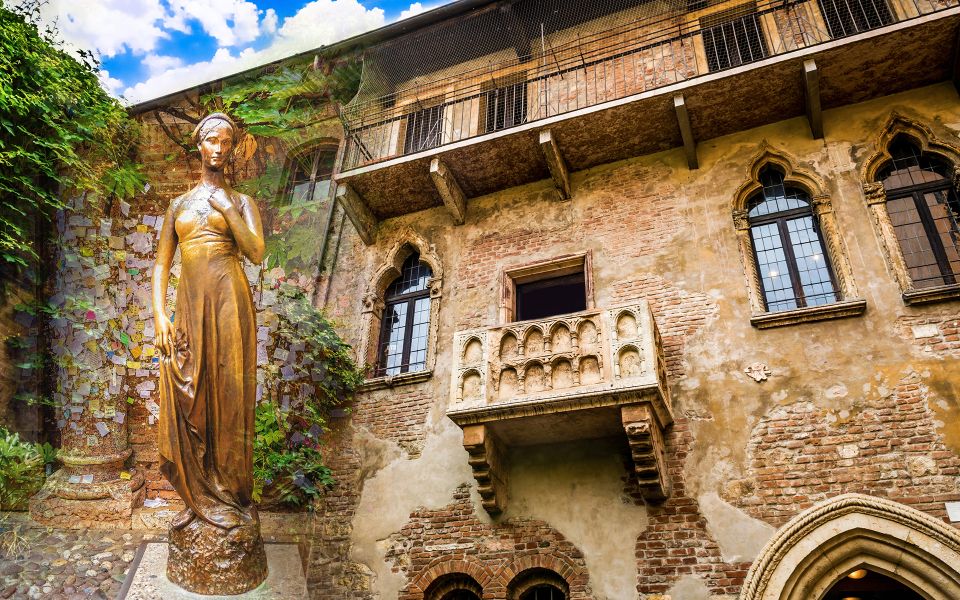
Casa di Giulietta is the reason most people point their feet toward Verona in the first place. The tour frames it as the setting tied to Shakespeare’s romantic and tragic love story, and it helps you separate the building itself from the marketing around it.
The core facts matter here. The building dates back to the 12th century, and at one time it was owned by the Dal Cappello family. Their coat-of-arms is carved into the keystone of the courtyard inner archway.
Then there’s the name connection that turned into folklore: the tour explains how the identification of Cappello with Capuleti fueled the belief that Shakespeare drew inspiration from a real rivalry and forbidden love. Whether you treat the story as legend or legend-with-a-pinch-of-truth, a guide helps you understand why people keep returning to the courtyard and imagining the scene.
This stop is listed as 10 minutes and admission ticket free. The tour also ends nearby Juliet’s Balcony, so you can extend the experience at your own pace afterward.
When a private guide actually adds value
At $279.98 per group (up to 2) for about 2 hours 30 minutes, the “is it worth it?” question is fair. Here’s what you’re really paying for: less wandering, more meaning, and the ability to steer the pace.
The itinerary is compact, but the guide layer makes it count. A great guide does two things at once:
1) points out what you’d miss without clues
2) gives you a story thread so individual sights connect
In the feedback tied to specific guides like Cecilia and Priscilla, the common theme is that they brought energy and made the city feel alive through explanations. That matters in Verona, where the landmarks are gorgeous, but the connections between eras can be easy to miss if you’re only reading plaques.
Still, it’s smart to consider your own style. If you want lots of back-and-forth questions, set that expectation early at the start of the walk. A private setting is your advantage—use it.
Also note: the tour includes a licensed guide and runs in English, with a mobile ticket. That combination helps you get moving quickly instead of burning time figuring out what’s where.
How to get the most from the route (without turning it into stress)
This tour is built for people who want to “get their bearings fast” and then explore. You’ll see the Roman scale at the Arena, shift to Scaliger-era defense and civic symbolism, and end in the Juliet area where you can keep going on your own.
I’d plan your day so you’re not trying to sprint from place to place right before or right after. The route finishes near Casa di Giulietta, so it’s easy to continue with nearby streets and viewpoints at your own tempo.
Because lunch isn’t included, I recommend thinking ahead about where you want your first sit-down meal afterward. If you know you’ll want a proper lunch, you’ll enjoy the tour more when you’re not already mentally calculating your next food stop.
Who should book this tour, and who might pass
This private highlight walk is best for:
- couples or solo travelers who like a guide but don’t want group pacing
- first-time visitors who want Roman + medieval + Juliet in one clean loop
- people who prefer understanding landmarks in context, not just photos
You might skip it if you’re the type who wants long, ticket-based time inside major attractions. This tour is designed as a walking overview of key exterior and central sites, with short stops (often about 10 minutes) that keep the day moving.
Should you book the Verona City Highlights Private Tour?
I’d book it if your goal is a smart first pass through Verona. The price reflects a private setup for up to two people, and the time is used efficiently: Roman spectacle at the Arena, Scaliger power at the castle and bridges, civic texture in the piazzas, and then the Juliet finale.
If you’re excited by stories—how places changed hands, how monuments were rebuilt, and why certain squares still matter—the tour gives you that thread quickly. And because you end near Casa di Giulietta, you can choose how long to stay in the romance zone after the walking part ends.
If you prefer a totally self-guided day, you can also do Verona without a guide. But if you want to arrive with curiosity and leave with a sense of order, this one is a strong bet.
FAQ
How long is the Verona City Highlights Private Tour?
The tour is about 2 hours 30 minutes.
What’s the group size limit?
It’s a private tour for only your group, up to 2 people per group.
Where does the tour start and end?
It starts in Piazza Bra, Verona, and ends nearby Casa di Giulietta on Via Cappello (near Juliet’s Balcony).
What language is the tour offered in?
The tour is offered in English.
Is lunch included?
No, lunch is not included.
Are there entrance fees for the stops?
The plan lists several stops as admission ticket free, including Piazza delle Erbe, Arche Scaligere, Piazza dei Signori, and Casa di Giulietta.